Redesigning a 2.8 kg Medical Prototype into a 680 g Portable Wearable
Overview
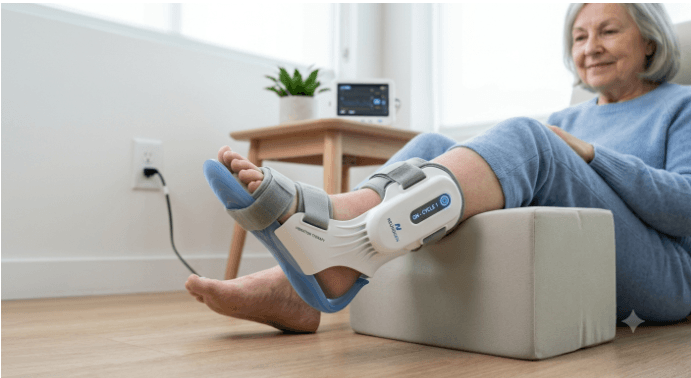
A MedTech startup had developed a breakthrough, patented dual-frequency vibration algorithm designed to stimulate damaged plantar nerves in diabetic patients.While the core technology was effective, the functional proof-of-concept presented critical commercial barriers:Excessive Weight & Tethered Power: The prototype weighed 2.8 kg, required an AC wall outlet, and lacked protective housing.Severe Ergonomic Friction: Standard footwear molds failed to accommodate elderly users experiencing localized swelling (edema), joint stiffness, or foot deformities.Compliance & Production Gaps: The concept needed structural optimization to align with FDA human factors guidelines and volume injection molding requirements.Step-by-Step Engineering Execution1. Ergonomic Mapping for Diabetic DemographicsDiabetic feet rarely fit standard size molds. We analyzed lower-limb and foot dimension datasets covering the 95th-percentile diabetic demographic to engineer an adjustable, open-heel footplate shell. This open architecture eliminated pressure spikes and safely accommodated localized swelling without restricting movement.2. Targeted Vibration Isolation (Shore 40A)Vibration therapy only works if energy reaches the target nerve endings rather than dissipating into the casing. We built a decoupled internal floating motor chassis using custom silicone mounts rated at Shore 40A durometer. This isolated the high-frequency vibration internally, directing energy directly to the plantar nerves while keeping external casing vibration minimal. 3. Rapid Prototyping & Field ValidationTo validate fit and comfort early, we fabricated functional iteration models using Selective Laser Sintering (SLS) with Nylon PA12. Conducting live patient field trials with these 3D-printed units allowed us to verify structural integrity, tactile feedback, and ergonomic comfort prior to cutting hard tooling.4. DFM & Injection Molding OptimizationTo prepare the device for high-volume manufacturing, we streamlined the enclosure into 4 key snap-and-boss plastic components. By maintaining a uniform 2.5 mm wall thickness, incorporating 1.5° draft angles, and adding strategic internal ribbing, we eliminated part warping during production while slashing estimated tooling costs by 35%.Impact & Key Engineering Metrics Performance Metric Initial Bench-Top Prototype Final FDA-Ready Wearable Engineering Impact System Weight 2.8 kg 680 g 75.7% Mass Reduction Power Architecture Tethered AC Wall Power 3.7V Li-Ion Battery 12 Cycles / Charge Enclosure Structure Unhoused / Exposed 4-Piece Snap-Fit Shell Production-Ready & Durable Tooling Expense Baseline 35% Cost Reduction Optimized via DFM Ribbing & Walls